Wednesday, 13 May 2015

The Art of Asia Schultz

Asia Schultz at only twenty-one years of age is a talented young artist, enrolled in the Lakehead University Fine Arts program. Her talent at mixing both high art and low art is a great example of style mixing where some influences come from established English portrait artists like Lucien Freud, Tai-Shan Schierenberg, Francis Bacon, and German artist Max Beckman.
     However, Asia is unusual in that she successfully blends into her work styles from such disparate Japanese artists as animator Hayao Miyazaki and any number of artists who create anime characters that can be found most easily in online web comics, both professionally designed and created by amateurs from all over the world.
     Born and raised in Thunder Bay Asia’s first major influence in style came from the darker works of artist Clint Kraft who teaches at Hammarskjhold High School.
     “Mr. Kraft was great for not limiting us,” says Asia. “He was really open to letting us explore what we really wanted to explore, which I really appreciated. He never told us we had to work in a particular style, like work only in realism or work only in abstract. He let us try a lot of things.”
     Asia began her university education enrolled in psychology, but had her love of drawing rekindled dramatically in her second year in Quinten Maki’s drawing class. She then decided to enroll full time in the fine arts program where she also discovered she had a great love of art history, thoroughly enjoying Christi Holmes’ classes, where Asia says the students are allowed to explore some of their own interpretations of how art history evolved.
     Asia is also unusual in that she had a bit of a head start in her artistic education in a way that most artists can only dream of, not only was she born with some talent, she had an artistic compatriot who was an easily accessible companion who could influence and motivate her by being extremely critical without causing any sting, insecurity or doubt.
    Asia has an identical twin who also likes to draw.
    And true to twins, although they share some of the same traits and interests, each is their own person with completely different personalities. Asia’s sister, Kimberly, is not studying art at university, but continues to enjoy drawing “as a side thing.”
   Asia explains that as children, “Me and my twin sister, we didn’t really have any artistic influences in our lives. So Kimberley and I would spend a lot of time drawing together. It was simple to do and we liked to see what the other could do. We would choose the same thing to draw and see how each other drew it. It was interesting to see how the other interpreted the subject, but we grew to develop our own styles. …. It was something that we could improve daily and practice without being competitive, not trying to outdo each other. I always had someone who could give me confidence. It was a lot of back and forth that helped us. We never judged. And we never thought something was taboo. We got lot of encouragement from each other.”
     In conversation Asia talks about influence from her favourite Miyazaki film, Kiki’s Delivery Service, the Vampire Hunter D series, graphic novels, kids cartoons and something called “gemsonas,” which are cartoon portraits made of oneself, inspired Steven Universe, a spinoff of Adventure Time.
     “I like kids cartoons that don’t underestimate the intelligence of children. They [the creators] understand they have large audiences so they try to make it interesting for everyone.”
     So when it comes to painting and finding her own style, Asia isn’t on a mission to find one style to express herself.
       “I enjoy the fine arts and the intelligence of it and what can grow in that specific mindset, but I do like the mainstream art culture and the pop culture elements that allow you to explore aspects that may not be art but allow you do to your own cartoons, your own animations. I really do enjoy doing figurative works that tests my intelligence and challenge how I can portray something. Painting is where I am better at exploring figurative works. Drawing is where I explore other things, like handmade animations, getting back to your roots in drawing without having to worry about being super polished.” Asia adds, smiling, “And I like working in a gothicky Victorian aesthetic.”
     When asked what kind of advice she would give to young, up and coming artists, Asia offers up insightful multiple suggestions.
     “I learned a lot from copying other artists. I explored already well-received artistic styles, and looked into what exactly I could offer, what my voice could be. I didn’t have to worry what people thought, because I was working in a style that people already loved. I’m learning to become an individual – even though everything has already been done.”
      “You shouldn’t feel self-conscious about what you want to do. Don’t get caught up in comparing yourself to the great masters. You can still be good at what you want to do without creating great masterpieces.”

     After some thought she adds, “There’s no one way to be a great artist. Especially now, there are so many ways to create art. And it’s really important. Web comic artists, artists on Tumblr, they reveal how people have come to grow into many styles.”  

Thursday, 30 April 2015

The Art of Candace Twance


     In her element as a mother, artist and partner to a talented musician, Candace Twance is full of smiles, ideas, and energy. Her buoyant spirit is infectious and evident in her colourful and dynamic paintings. You can see in the images above how she plays and/or experiments with technique and style.
     Candace grew up with two brothers and two sisters in Port Arthur and hails from Pic Mobert Reserve, four hours East of Thunder Bay. She studied Fine Arts at Lakehead University, and while focusing on painting, she states, “Lakehead sped up my skill development and I was able to try different things… learn different techniques and see what style I was most drawn to.”
     With Ojibwe and Ukrainian ancestry, Candace says, “I’m always going to be described as an indigenous artist, and although my work could be seen as woodland, it is contemporary. I incorporate mixed media and abstraction, but my work is always figurative and narrative. I’m interested in people from my community, my native ancestors.”
     Her latest series, including four large-scale paintings, incorporate people into woodlands themes. “I smush a lot of beads and objects into my paintings, in an abstract way. I’m incorporating craft into dynamic abstract images that are tied to the land.”
     Candace has received three grants to help her with her work, so she’s grateful for the support of the Aboriginal Arts Grant and the Ontario Arts Council that have helped keep her full time as an artist. “Lately I’ve been getting a lot of commissions, portrait works mostly. So I’m doing that as well.”
     Recent inspiration has come from photographs taken early in the 20th century. “My dad has a bunch of black and white photographs of my family and community. Many are old fur trade images. No one is smiling,” she laughs. “They’re not like the Curtis photos. They’re wearing modern clothing and are really cool and inspiring, so I’m incorporating them into my paintings.”
     Candace is also doing research for another series, beginning with a large instillation piece. “It’s going to require a big space. I want to show, in layers, spirit realms… as homage to my ancestors, so I’m going to produce a section of a house with ordinary objects made extraordinary. I want to express, through different sensory elements using light and sound, the existence of a different realm to give a sense of presence in a room that is invisible.” Candace smiles and waves her hands in rejection, “But not like a haunted house.”
     Again, expressive with her hands, Candace looks to the ceiling, thinking aloud. “Have you ever gone into to an abandoned house, a special place, a sacred place, with ordinary items, but all elevated somehow? I want to do that, through adornment and create a surreal experience. I want to provoke that feeling from people. I’ve wanted to do an instillation like this for a long time. And I’d love to tour it to communities, to reserves.”
     With two young children Candace has trouble finding time to paint, but she grabs an hour or two when she can. However while she’s caring for her children, she plans out ideas. “I formulate what I’m going to do in my mind so by the time I come to paint I have a pretty good idea of what I’m going to do.”
     Candace wants her children to follow their own path, yet hopes they will have an appreciation of art. “They motivate me to be successful. I wouldn’t say they inspire my work,” she laughs. “Don’t write that! It sounds so mean. Well… it’s inevitable that they will influence my art, and I do want to leave them a legacy.”
     Reflective of her early start as an artist and the success she’s had already, she adds, “I think you’re born to be an artist. I was born to do this. I was always creative, but in my teenage years I had the realization that it didn’t just have to be a hobby. It could be a career, but it felt like a risk to go to school for art. I didn’t know what kind of job I could get. I had other interests like social work, you know, to make money. But life chooses you. You have to embrace it.”
     Candace is also a musician, writing songs and playing guitar. Her partner Nick Sherman is a musician, who is releasing an album this May called, Knives and Wildrice. Candace and Nick both manage to make a living as artists. “Sometimes we look at each other and we’re amazed we’re doing this, that we’re going all in with our art. Some in our families ask, how do you do it? Some think of us as unemployed, but we’re both self-employed. I guess we’re lucky. When you choose to be an artist you’re either all in or you’re not.”
     Candace sighs and with a big smile she adds, “Ugh! I want to do so much work. I just need some time!”
     You can see some of Candace’s work at the new location of the Ahnisnabae Art Gallery downtown at 18 Court Street, HERE, and Candace Twance, Anishnaabe Artist on Facebook.

Thursday, 16 April 2015

Graphic Novel in the Works: "Daniel Stronger" by Elliot Doxtater-Wynn


You may know Elliot from his CBC Superior Morning Radio Show. You may not know that he has designs to create an elaborately plotted graphic novel involving the growing pains and concerns of a young adult, with elements that any young adult will appreciate along with elements related directly with aboriginal youth, which should allow the novel to appeal to a diverse audience.
     Elliot is originally from Six Nations in Southern Ontario. He spent his formative years in Sudbury and Manitoulin Island where he went to Beal Vocational School to specialize in sculptural design and obtain a College level introduction into all visual art disciplines. He met his wife then and moved to Thunder Bay in 1997 to live and work. He also continued his education in the fine arts program at Lakehead University, specializing in sculpture, which involved traditional sculpture along with mixed media work, found objects, and installation.
     “Sculpture is a particular discipline, and even the spaces required are particular,” he says when he describes how more involved and problematic sculpture can be compared to other art disciplines. With his sculptural work he focused on environmental statements involving a love for the environment as a contrast to the amount of refuse we produce and how the two interact.
     He does earn more from his paintings and drawings and his work has been displayed at the Thunder Bay Art Gallery, at the Vancouver Olympics, and many Aboriginal Arts and Crafts shows. In 2014 he won the Thunder Bay Arts and Heritage Award for visual arts.
     When at LU he used his studio time to refine his own style to create imagery more recognizable as his own rather than what he considers to be more stereotypical Indian art. He also geared himself to graphic design and eventually his work gained interest, allowing him to get paid for producing works in his own style.
     His study drawings, created to generate ideas and to play with different approaches to design, reflect good drawing skills with some stream of conscious work. The drawings have that comic book feel in the Heavy Metal Mobius vein mixed with the subtle influence of Japanese anime. Clothing, symbols, hairstyles, objects and design elements still maintain the First Nations character. Many of his study drawings would make for great larger paintings.
     With his blended style Elliot is able to stick to his roots and maintain work that is relatable to a larger audience. And the style choice he’s made will come in handy when he finally puts it to work for him on a project that he’s had in mind for twenty years.
     Twenty years ago he did a cover page and that alone was enough to generate long lasting ideas. As he describes the work, he’s expressive with his hands and his face lights up in excitement of the memory. And he’s thrilled that he’s been able to obtain an Ontario Arts Council grant which has allowed him to move to the production phase.
     His graphic novel concept involves a young man named Daniel Stronger who becomes transformed after an accident. While in a coma, many years pass, but when he wakes he has miraculously remained only fifteen years old. And his parents are missing. Much like a superhero, he has to learn how to control the powers he’s mysteriously obtained while simultaneously dealing with the particularly awkward troubles of adolescence. The quest in the adventure is of Daniel searching for his parents and understanding and controlling his powers.
     However, there are other details that add much more depth and dimension to the story. Elliot gave a description of some, which will make Daniel Stronger’s adventure more complex, but they won’t be revealed for a long while.

Saturday, 4 April 2015

"Talent" is not a dirty word.

     Nature, in her wisdom, sprinkles talent indiscriminately amongst us, so that some lucky individuals are born with a genetic predisposition that allows them to do activities better than the rest of us. It doesn’t at all mean they will achieve anything with that specific genetic advantage because society has to allow for it to be fruitful and actively seek out the bestowed person and be encouraging. Parents, relatives, teachers and the public have to want talented people to succeed. And the individual with the talent may not know they have it and may not see any value in developing it. If there's no incentive to work at it, that itch they have as a child to draw or write or sing or dance or tell jokes won't last beyond childhood.  
     A country can do well by supporting the search for talent, no matter what the field; sports, arts, science, cooking, raising children, etc. and then provide good reasons for someone with talent to actually follow through. So, just as much as we need talented people to make life better for the rest of us, as we benefit from their exploits, as I do every time I turn on my laptop, a device created by a number of talented people, so we also need mentors, promoters, investors, agents, and critics. Talent shows might be tacky as all heck, but they can help. They're doing us a service that our friends daren't do, discern whether you have any ability or not. 
     Don't get me wrong, if you don't think you can win a talent competition, it doesn't in any way suggest you should stop singing or telling jokes. You might not get top marks, but you still are very valuable to all kinds of people. You just might not want to invest thousands of dollars in trying to make a living at it. 
     Sadly, many people, especially in the visual arts, see talent as a dirty word, and the search for it as something that will benefit a few at the expense of others. Some go so far as to say it doesn’t exist. It seems to be in our egalitarian nature to think that anyone can be an artist if they choose to be. Any time I'm with any sort of group of artists there's often someone there to remind us that, "anyone can be an artist."
     Funding and admiring only the talented seems grossly unfair. The problem, as we are all aware, is that we resent being told there is a wonderful film or art show worth seeing and when we go to the effort to check it out for ourselves, it turns out to be mediocre at best.
     In an art show a thousand mediocre works of art won’t make up for the one great inspiring piece that is missing. And much to the public's credit, more people than you think, actually have an ability to recognize a great work. The work often seems to sing for attention. It will have the effect of creating awe.
     With the invention of cameras, microscopes, wallpaper and colour printing, the ability to draw has been mistaken as a technological feat and not a human one. Many contemporary artists and critics too easily dismiss or undervalue an individual artist’s ability to create a vast range of subtleties in an image. They have thrown that ability into the dustbin of history, along with another, the ability revealed when an artist’s job or interest was the idiosyncratic application of allegory.
     This is where human emotions and actions can be read, where people’s desires and beliefs are recorded and can, over time, becomes part of history, so much so that history exists IN art, more artfully displayed than any camera or computer can achieve, until very recently. And even then, it takes an artist’s hand with enough skill to replace pencil and paper with stylus and pad and not make the image seem frozen. The difference between a photograph of any quality is nothing compared to a master painting filled with the artful use of texture and glazes.
     And of course there is the heavy handed weight of "the idea." A regular reader of this paper probably isn't aware that the traditional functions of art have been thrown under the bus in favour of lofty ideas, or philosophies of art. I'm not talking simply about "abstract" art. Some modernist and abstract art is valuable and quite good. What I'm talking about it when ideas become so strong in the art world that art, the work that physically exists in a gallery, becomes the byproduct of a way of thinking. Many university professors and their students get lost in their ideas, often having no application whatsoever in a world either outside of where the ideas are studied or where the byproducts are displayed, typically a gallery. 
     Or maybe I’m just a snob.
     Malcolm Gladwell argues in his book, Outliers, that all anyone needs to be good at something is ten thousand hours of practice. So in approximately ten years no matter who you are you will be good if not great at whatever it is you choose to do.
     Really? Sure, some can take ten years out of their lives to write a novel if they really put their mind to it, which Gladwell uses as an example, and anyone can learn to play a guitar in ten years or belly dance or ski or whatever. But will they be great? Will a woman or man practicing guitar for ten years be as good as Andres Segovia, or Jim Hendrix or Steve Howe? What about the kids who play the violin or piano at the age of five or seven? What about rock bands that turn out dozens of number one hits while other bands can’t? What about sports stars who have bigger lung capacity, or are taller, or have whatever physical disposition giving them the advantage?
     Two friends of mine have been painting portraits and figure drawings for much longer than ten years. Neither have gone beyond a high school level of ability. But they love doing it. One, Elizabeth, decided to expand her ability and love of art and went back to Fine Art school at the University of Victoria. She now produces installation works that don't require any drawing skills.
     Another friend, Daniel, who I knew for five years in Victoria, and who I hadn't seen in ten years, invited me into his home in Ottawa. His studio was filled with portraits and figure drawings. I happened to visit him on the day before a model was to show up. He had turned his living room into a studio as well, complete with lights and a model stand. He was excited and animated and was keen to talk about his collection that covered all the walls of his house. He still has the little portrait he bought from Myfanwy Pavelic in Victoria. You've seen Myfanwy's painting of Pierre Trudeau on television in the halls of the Parliament building whenever a politician is interviewed in the hall.
     Daniel's enthusiasm and love of art is infectious. And being French-Canadian his accent and manic gesticulations inspire admiration for his determination. He LOVES painting. He LOVES the human face. He LOVES the body. Yet after all these years, even with all his love he will not show his paintings publicly. He will not sell his work. He knows it simply isn't good enough. And he doesn't care. He loves the journey.
     Just about anyone in any field of endeavour can name someone else they were inspired by or are jealous of because they seem to be naturally talented at doing their job. I’ve been jealous of a number of artists who can draw and paint better than me. Boo hoo. But I learn from them and admire their abilities. And I know that my particular métier, my subject matter is quite different from theirs, so I only get inspired rather than turned off.
      Some people equate the search for talented people as the Nietzsche inspired Nazi search for the white superman of the Aryan race where countries hold up our sports and science stars as evidence of their superiority over others. This is a terrible rabbit hole to go down. But there are people who freak out when they hear the word “talent.” Or when they meet someone they think is more talented than them. I've met a few.
     I was invited to a drawing session in East Vancouver by an artist who just had a sellout show at a prominent gallery on Granville Street. We stood with our drawing boards next to each other and we had a clear view of each other's work. He drew in a Mannerist style. That night I was more Raphael. During the session, he became clearly more and more agitated as time went on. We barely talked. I realized soon enough that he had become insanely jealous. He began commenting on how organized I was, how sharp my pencils were. "They look like daggers." And after a few snide comments, often said with a smile, thinking he was funny, he said. "You know, you're a lot like Hitler." 
     There have been a number of books on the subject of how talent is a myth. Books on contemporary art often argue that the ability to draw is merely mechanical and that the attempt to find and create beauty is a shallow affair. They devalue the ability to draw and paint, which for thousands of years was the one qualifying ability that made a visual artist an artist. And Canadian Art magazine often features articles where inevitably the artist or critic or gallery owner states that popular art is the enemy of culture. Really? Pop-culture? Your biggest enemy? 
     There are genetic predispositions that allow some people to do activities better than the rest of us but only occur in an individual and not in that individual’s children. Sometimes talent skips a generation, like baldness. Maybe talent, on occasion, is a genetic benefit and rare, because nature in her evolutionary wisdom, or imperfection, sprinkles talent indiscriminately throughout a population no matter what their sex or race, like some forms of diseases? Are child prodigies the victims of a beneficial brain disease?
     Anyway, I’ve decided to write about individual Thunder Bay artists for the next two or three months to help them out. I’m looking to write more about talented female artists and First Nation artists. If you have any suggestions, please write to duncanweller@hotmail.com.
    As an extra personal note, not printed in the CJ, I thought I should add that I never applied for a grant until I won a couple awards. When society gave me an indication that I might be of value, I decided I was worth other people's money. I've invested that money in my work and I'm happily making a living at doing what I love. Also, in my twenties, I saw artists who had no artistic ability, as far as I could tell, who received grants, and I was amazed that their work was getting support. Previous to winning the awards, I thought of grants for artists as welfare money. When I realized that a "best-selling" book in Canada is only at around 5,000 copies, I realized that I might as well be a welfare recipient. The chances of making a living in our current system, simply wasn't going to happen. I decided to dump the publishing industry and do it myself. So far so great.


Friday, 27 February 2015

Chris Rantala

     Chris Rantala battles the wall of wind and snow kicked up between the buildings along Cumberland in the North Core. With a bit of difficulty he manages to get the heavy signboard he’s just completed safely off the back of his truck. He carries the signboard into Espresso Joya, a new espresso bar and gallery. With its arrival, Thomas White, the owner, beams with delight, thrilled with its look and weight. “It certainly won’t get blown over by the wind,” he states.
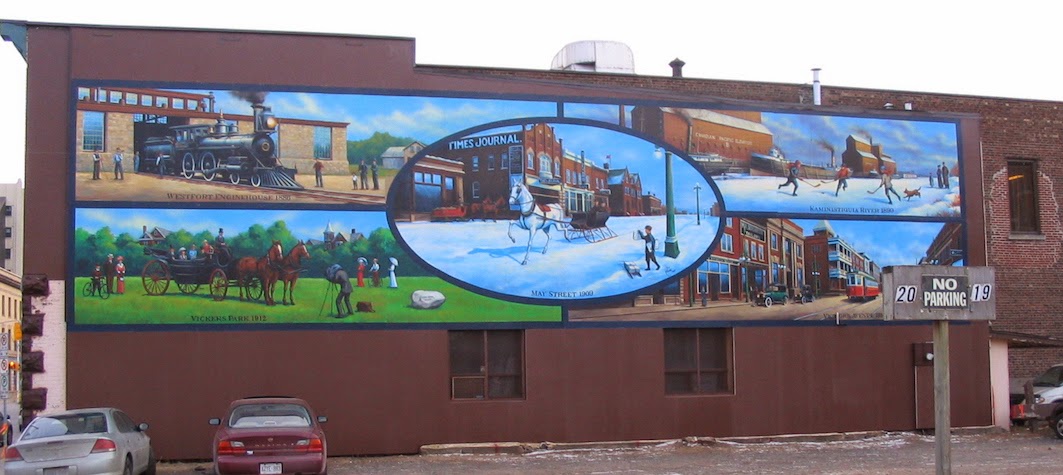
     Chris Rantala is a full time Thunder Bay artist, who has found a supportive community willing to commission him for a wide variety of projects, many you have seen as murals. He’s done about five large murals and twenty smaller pieces that can be found in town and in Kakabeka. He’s also taken commissions for signage, elaborate goalie helmets, funky motorcycle tanks, paintings of children, people in canoes, general portraits both human and animal, trains, classic cars, fighter planes and even an image of a wood chipper with delivery trucks.
     Chris laughs with an understanding of the sentiment involved in the wood chipping commission, “Some of it’s not art, but it pays the bills.” However, he doesn’t put down the commission work at all. His love of the antique and Thunder Bay’s past has melded well with the desire of the people who commission him. He does his research, visiting the Thunder Bay Museum and the Archives, looking at old photos and old film reels.
     “Creating a scene is a bit like being an archeologist,” Chris says. “I find it really interesting; digging up old imagery and discovering stuff you’ve never heard of before. I never knew there were racing tracks in Thunder Bay back in the 1930s.”
     Despite his enthusiasm for making a living as an artist and his success with multiple commissions, he’s excited about his prospects as a future graphic novelist, sketching out characters and ideas for what will be his break into more personal work. A big project like a graphic novel will stretch his imagination and talents, as he has to battle with an intricate story line and create many hundreds of images. His elaborate and detailed sketches indicate his love of a future past where technologies, fashion and design elements are jumbled into something similar to that of the steam-punk mix.
      He spent his childhood in Kakabeka and lives in the house his father built. His artistic influence came mostly from his father and a talented aunt and uncle duo. He adds modestly, “There’s the cliché that I was born with a pencil in my hand. I was drawing as early as I can remember. I was drawing pictures of cars and houses on the back of my dad’s envelopes when I was three years old.”
     “I was always aware that I was going to be an artist. I remember when in kindergarten we were put in smocks with easels set up. I painted a steam engine with a caboose. The painting was shown to the principal and my parents. They were all impressed that I was doing more than stick figures. From that day forward that’s what I knew I wanted to be; an artist.”
     He went to Sheridan College, in Oakville, studying classical animation, character design and layout. Figure drawing is enforced at Sheridan and this had a huge influence on Chris. As important to him was the study of scene setting where characters had to be dropped into an historically accurate scene, complete with a suggested storyline and perspective.
     In his third year at Sheridan, Chris’s father passed away. Chris greatly admired his father for living a self-employed lifestyle; building houses and replicating Victorian furniture from old Sears catalogues. Chris’s father had encouraged him to follow his passion.
      More recently Chris completed a snow sculpture of Little Red Riding Hood for Winterfest, with help from his girlfriend, Becky Davis. Chris has created a few sculptures of his own, hoping to do more with his own spin, creating personal works involving humour and surprise elements, mixing the familiar with the new. Meanwhile he’s got his plate full of upcoming commission projects. And he’s continuing to sell his work at craft and art shows. Chris Rantala can be reached at chrisran88@gmail.com.

Friday, 13 February 2015

Urban Infill and 3 New DEFSUP Shows: 2015


    The Definitely Superior Art Gallery is back in full swing on a number of fronts, encompassing dynamic art shows in their three gallery spaces, infusing businesses and unoccupied spaces of the North core of the city by incorporating art into eighteen venues and by offering musical and video performances in different locales.
     The gala opening for all of this is tomorrow night, 7pm at the gallery, located at 250 Park Avenue, just up from the Casino.
     Ongoing since January and ending April 25th is Urban Infill-Art In The Core 9 with the lofty goal to revitalize downtrodden downtown. Port Arthur is already a hotspot for foodies with several new restaurants and the imminent opening of an espresso bar where Atkinson’s Jewelers was once located.
     Variety is key to Urban Infill with the idea to turn the Waterfront District, for a short while, into an arts and entertainment district. The event combines commercial venues with self-expression, which may not encourage sales directly, but allows individual artists to make statements publicly allowing them to reach an audience they might not ordinarily access. More so, Urban Infill temporarily decorates empty spaces and commercial venues, suggesting future alternatives and possibilities. A key factor is the element of surprise, pushing aside the mundane momentarily and giving you something to talk about. Also Urban Infill might present to businesses and local politicians the potential value of incorporating art into a business district.
     In Gallery One at DEFSUP is a painting and film instillation by Toronto based Cary Waito called Microgeographica. The show is comprised of paintings of minerals you might find in a rock shop, but painted lovingly to capture the light, texture and elemental nature of the stones and crystals. Without a setting the objects float freely as if created for a geology catalogue. If it weren’t for the wonderful handling of the paint and colours the realism would leave you a little cold.
     In Gallery Two, Polish Canadian artist Dagmara Genda is very accomplished at drawing and collage, creating dynamic apocalyptic and explosive scenes incorporating animals, architecture, and other objects. Her show is called Panorama/Corrupted Animals. As the title suggests, she is like a mad scientist, but on paper, where she rips apart things and recombines them to create swirling masses of floating chaos. Each work encourages close inspection as she uses lots of contrasting imagery to joggle your brain.
     In Gallery Three, another artist who likes to reanimate by recombining animal and human body parts is Julia Pott, an award winning British animator. Her films combine fear, sex and obscene violence enacted out on cute teddy bear like creatures. Although employing the macabre, the films will appeal to your dark side and draw out sympathies and empathy very quickly when you least expect it. For some it might be an emotional rollercoaster ride.
     Opening night features a musical performance by Nancy Pants, featuring Adam Waito. This is a Montreal based “dirty pop band” and described by one reviewer as performing “teenage ‘60s garage pop and weird ‘90s punk.” They are considered a band that is going places. And you will be able to dance to the music.
     For more information please go to: www.definitelysuperior.com. To see videos by Julio Pott go to: www.vimeo.com/user2401669

Saturday, 3 January 2015

Vision Board for the New Year and the Practical World of Your Unacknowledged Artistic Practice in Comparison to the Big Art World

What might help you get beyond February with your new year’s resolutions is to create a list with priorities labeled A to D, where C and D represent nothing to sweat over if you don’t get them done. According to Anthony Robbins, if you do three things every day on any of your lists, including C and D, you will eventually reach your goals and be a happy person. That is, of course, if there is no economic meltdown.
     For added help, try a little new age motivational thinking by attaching images of your dream home, camp, car, boat, jewelry, spouse, body, friends, children, pets, etc. from the Internet or magazines to your A and B list priorities. Paste these images to a board and place the board on the fridge door or above the dresser. One day, these dreams will magically come true.
    However wary you might be of vision boards, wish fulfillment and mystic relationships between imagery and reality, you are no doubt already performing what artists have been hired to do since the stone age; mimesis and generating feelings of plenty.  
     When photography was invented and the digital revolution added to the ease at which ordinary citizens could obtain imagery, artists were left lurching. It’s no surprise that in order for artists to survive they often became quasi-philosophers and gurus producing pseudo-art, each declaring that their art was superior to the last batch of artists in order to attract wealthy patrons, their lifeblood. This created a phenomenal number of art movements in a short period of time in the 19th and 20th Centuries. For every art movement you’ve heard of there were a hundred others that never made it to the history books.
     Today, modern art movements fall under the banner of “Contemporary.” This is a scheme to ensure that contemporary artists are no longer constantly trumping each other with their own brand, essentially invalidating and killing off other movements. When Pablo Picasso died in 1971, there was a collective sigh of relief amongst artists. He alone symbolized the entire modern movement, magnetically sucking art history to his chest. When he entered Intellectual Byzantium, otherwise known as the history books, which is essentially heaven for artists, it was then possible for someone else to be the next great guru. But no one wants to be left out of heaven, so an unconscious collective agreement grew under the banner of “Post-Modernism” and then Contemporary art, to be more egalitarian and inclusive. No one person, or one group, was allowed to be the one great thing. Every artist got the chance to be a somebody if they showed in a gallery and then catalogued.
     Unfortunately, this has lead to a permanent stasis, which critics call “Presentism.” Contemporary artists have created a new problem for themselves: desperately trying to be relevant without being too original or so new that you upset other artists and critics whose lifeblood depends upon control. No one movement and certainly no one artist dare take the reigns of art history.  
     Mind you, I’m talking about the world of big galleries and art magazines. It really doesn’t have to concern you at all, until you get an ugly contemporary art sculpture dropped in your local park. Or a really ugly building dropped in a downtown core. Well, maybe it does concern you.
     In any case, in your own home and life, you have become the artist. You won’t be shamed by anyone these days for not owning an original work of art. Even by artists. They understand. Framing is expensive. Original art is expensive. There are more important things you can spend your money on, like the latest flat screen TV and speaker system.
     Every time you download a picture, make a video, take a photograph, print a photo and hang pictures on your walls you are being the visual creator. You create your own footprint with the visual imagery you choose.
     This includes all those pictures you have of your friends and family, some that you share on Facebook. It’s the posters of places you’ve travelled, the photos of past loved ones, the pictures you have of your kids and pets and previous homes. It’s the pictures of people who inspire you. It’s the teenager’s bedroom with the spaceships and cars and hockey players and sexy girls and/or sexy boys and rock bands and country music stars and… on and on. All of this is mimesis, images reproduced and generated to give you feelings of pleasure and that act as a statement of who you are and what you love.
     Repeating images generates feelings of plenty. Multiple images can reinforce the idea that you’re active and alive. Repetition creates a sense of movement. This is why you have more than one photo of a loved one in your home. It explains why we take thousands of unnecessary photographs. It makes you feel comfortable, which explains some people’s strange desire to collect things, including hoarders. You generally feel better when the fridge is full. It keeps death at bay. You certainly feel better if you hang pictures of your family and friends and of places you’ve been and things you’ve done. You can look at your walls and see how full your life has been. It makes death easier to take. Blank walls are too empty and austere.
     You are satisfying basic needs once performed by visual artists.
     But it’s still nice if you do support local artists. If you want to stand out as someone of taste and status, buying art is the way to go. What artists can do for you is enhance the imagery that you have in your home by making it one of a kind, either as a piece that is characteristic of the artist’s style or a work that you commission where you instruct the artist what to paint or photograph or sculpt. You can better create your own original personal history that speaks more to your character, and adds to the visual world that you see on a daily basis. Photographers can get a better shot than you and visual artists can apply metaphor and allegory and fantasy to anything you like, making what you own truly original.
     If the life you lead is as good as it gets and you are happily settled, maybe you don’t need that vision board. Maybe you just need a little enhancement. That’s where the art world can help you out.  

Thursday, 18 December 2014

Underwhelming National Coverage of the Arts in Canadian News

      An excitable acquaintance of mine, big on conspiracy theories, maintains that Canadian television news won’t feature Canadian artists unless their work sells for exorbitant prices or is stolen or vandalized. This is because the Harper government wants to limit the dissemination of a variety of opinions and distract us from real and alternative issues that writers and artists deal with as representatives of a diverse society. This is also why, she says, Canadian news covers popular American movies, American TV shows and hockey stories that are as inane as players getting the mumps or the Edmonton Oiler’s losing streak. Hockey is the soma of the masses!
     In Canada coverage of the arts varies provincially. TV Ontario and CBC radio do a passable job of covering the arts, but our national news programs can certainly be criticized for not covering the arts as well as they should. With 24-hour news cycles, you would think they could at least drop in a half hour show on the arts in Canada somewhere. They should be embarrassed that they don’t.
     Unlike regular sports, science, health, or business contributors and commentators who we are familiar with, the closest CBC or CTV has to a regular “arts” contributor is Ben Mulroney, yikes!, or a regularly featured film critic. It would be wonderful if the CBC and CTV at least had an arts contributor as prominent as their science reporter, Bob McDonald or financial news commentator, Pattie Lovett Reid.
     Unless a prominent Canadian writer or artist dies, or when a former CBC/CTV reporter turned novelist puts out a book, there is very little coverage nationally of the arts. And when we do see writers, because we only hear about painters when they’re dead, we keep seeing the same few faces over and over again. How much of Margaret Atwood or convicted criminal Conrad Black can you take? And they’re both in their seventies. Where are all the young talented Canadian artists?
     By comparison the Americans do a pretty good job of covering the arts, maybe not on CNN or other 24-hour news programs, but PBS does, as do morning news programs on ABC, CBS, and NBC. And then there are the satirical news programs on the comedy channel, The Daily Show and the Colbert Report, where both have one interview segment, sometimes two, featuring a diversity of artists. And then there are the other late night comedy shows, which might not feature many fine artists, but the diversity of the popular arts covered is refreshing and surprising by comparison.  
     On many American programs, writers, painters, poets, sculptors, designers, architects, playwrights, etc. are continually interviewed to discuss their latest works or their extensive and often historic involvement in the arts. And every once in a while you will see Canadian writer or actor on these shows, with extensive interviews on the PBS NewsHour. All this coverage of the arts contribute to building a rich and diverse culture in the United States, one in which we Canadians are familiar with and ultimately copy, whether or not we’re talking about popular art or fine art.
     Unless you make a real effort, or are part of the scene, you wouldn’t know if there was some kind of new art movement in the visual arts or new poetry or new theatre or new anything going on in Canada. Unless it’s something like Cirque du Soleil, raising truckloads of money, or has won an international award, the public is unlikely to hear about it.
      We do hear about the Giller Prize winners because a real effort is made with a live televised broadcast. And we do have televised award ceremonies; the Junos for popular music, the Screen Awards for film, Gemini for film and TV, but have you watched any of these from start to finish? It’s nice to hear that Canadians are getting awards, but it’s very likely that you know little to nothing about all the nominated artists. There’s little excitement for these shows because we hear so little about anyone being nominated. It’s like watching an award ceremony based in Quebec or a European country.  
      At least the award ceremonies announce what might be really good and valuable for us to look into, when we get the time.
     It was a rare occasion, and delightful to see two of Thunder Bay’s own talented animators Shayne Ehman and Seth Scriver followed around at the Toronto International Film Festival where they won the award for Best Canadian First Feature Film. We need more of this kind of thing, but not just for award winners, but for all the hard working artists who produce great work, whether or not they get grants or awards, for we live in a large country and not in Toronto.
     That national Canadian TV news can’t cover the arts better than a couple comedy shows on American television says a lot. But is there a conspiracy involved? Hmmm.

Thursday, 4 December 2014

December Dreams: Rotary Club Helps Artists amongst other Charitable Work

     For the last seven years, one of the most successful venues for artists to sell their work has been December Dreams, (photos by Clint Kuschak) which is happening this weekend at the CLE Coliseum. At this event there are over sixty vendors representing about a hundred different artists. Only twelve of the vendors also sell their wares at Artisans Northwest, an artist run event, which occurred two weeks ago.
     Artisans Northwest has been a very successful artist run event lasting over two decades, which is rare. Generally, such large artist run events don’t last more than a couple years. They’re difficult to manage, somewhat expensive and rely on a lot of good will. The Lakehead Rotary Club of Thunder Bay supports December Dreams, so the artists don’t have to step on each other’s toes, organize the finances for advertising, or run an artist jury system, which has it’s pros and cons. 
     Local artist Linda Dell did the bulk of the work to manage her novel concept called Art Zoom, a few years back. With limited funds and assistance, she put on a very successful event in Port Arthur to mix artists and businesses together. I took over the next year when she decided she couldn’t handle the workload involved. I quickly discovered how taxing it was to organize such a big event. Art Zoom ended simply because there were too few people to assist and little financial support. One day Art Zoom might be resurrected, but it would be great to join forces with a larger organization as December Dreams has done.   
    So, special thanks and commendations can be given to the Rotary organizers who manage December Dreams and the many volunteers for their support over the last seven years. The volunteers number over twenty each year. They help set up the booths and tables, supervise the door, assist the artists, keep the place clean and serve the public.
     December Dreams was an idea that Clint Kuschak and his wife Barbara, both local artists, came up with eight years ago. It was then that Clint saw the need for another venue when two other artist run events shut down. In Thunder Bay artists have work available in various shops throughout the city, so bigger events are a great way to get them all under one roof. As a member of the rotary club Clint pitched the idea to other members that a big two-day sales event supporting local artists could also be a fundraising event for the Club.
    Usually, Rotarians are associated with helping to eradicate polio from the planet, and with supporting hospitals, shelter houses, food banks, kettle campaigns with the Salvation Army and other social causes. It’s all humanitarian stuff. So, what’s the deal with helping artists?
     “Rotary work is done by helping artists, who have low incomes. We help them get more money to continue doing the work they love,” says Clint. “I’m very pleased that my Rotarians got behind this not only as a way of raising funds for the Rotary Club, but of community building through the arts. This is a great opportunity to purchase regionally hand-produced items of all kinds from their creators who come from as far away as Kenora West, Terrace Bay East, and points further North.”
      At December Dreams you can expect to see only hand-made items, such as pottery, paintings, knits, festive foods, Christmas decorations, Santa socks, books, jewelry, beading, woodworking, leather works, stone carvings, chainmail creations, handmade knives and handles, photography, handmade fishing lures, and much more.
      Many vendors are participating for the first time this year and you can meet the creators at their booths, which is very unlike a shopping mall or box store. As a result you can haggle and commission artists on the spot. It’s a rare opportunity to see so many artists in one place. The minimal door fee of two dollars, for anyone twelve years of age and older, will go to local charities. Items range in prince from two dollars to two hundred.
     December Dreams runs on Saturday from 9am to 5pm and Sunday from 11am to 4pm. Get details about December Dreams and the Lakehead Rotary Club at: www.lakeheadrotary.com.

Wednesday, 19 November 2014

Artisans Northwest: Over 75 Artists at the Valhalla Inn including The Potter's Guild

     Quality art and crafts from our Northern Region can be found at the biggest event of its kind at the Valhalla Inn this Saturday and Sunday.  This is an artist run event with a jury process to ensure quality work is up for sale, which results in a continuing high turnout of local art fans and tourists, and many happy artists.
     Every year in November about seventy-five artists are corralled into one of the classiest spaces available for hosting large events, the Valhalla, which has a long history of being of great benefit to the city. Local artists also benefit greatly from this event not only because it takes place in an awesome location, but also because local artists typically sell their work in smaller venues throughout the city as there isn’t one big venue that is as accommodating.
     How to access the public is an ongoing conversation that artists have. Thunder Bay is a city without a major center that everyone can agree upon, although of late, great steps have been taken by the city to further identify a North core and South core with beautification projects. But for now, as much as this city has all sorts of benefits over bigger cities for its lack of traffic and easy access to nature, and more benefits of smaller communities with better shopping and services, the cultural realm where its citizens can interact more easily with local creative individuals is still wanting.
     Artist groups sometimes shift locations from one venue to another, like the Lakehead Visual Artists. Individual artists will rent an empty space or a room at a community centre as Peggy Moran did last Sunday when she showed her explosive works at the Oliver Road Community Centre. The Walkabout group invites the public out to their homes. And there are sundry artsy venues, including the second floor of the Country Market, galleries and picture frame shops spread throughout the city that showcase artists work.  
     Many of the artists featured in Artisans Northwest also sell their work at the Fireweed, The Craft Collective, Authentique, Silk and Cedar, Gallery 33, the Baggage Building Arts Centre and other locations. You can find individual artists, and information about where they sell their work from a list provided by Artisans Northwest at: www.artisansnorthwest.ca/artisans.
   In terms of variety of quality handmade wares, you can’t do better than attend this event. With about three thousand people passing through on each day many are returning customers looking either to buy something similar that they bought the year before or they are searching for something new. Every year a few new artists are added to the rosters. Jury selection is done a few times throughout the year in a search for new artists. Admission is free. Saturday November 15, from 10am to 6pm and Sunday November 16, from 10am to 4pm.